

It’s your third agency pitch this week. The deck is polished, the logo slide is impressive, and the account lead has a confident number for how many leads they’ll deliver each month. You still can’t tell which of the three would move your pipeline.
To choose a B2B marketing agency, first figure out whether you have a traffic, conversion or positioning problem. Then hire the agency whose reporting lives in your CRM and whose definition of a qualified lead comes from your sales team. Those two things outweigh everything else in the pitch, logos and deck included.
Most agency hires go wrong before the first call. The buyer shows up without funnel numbers or a qualified-lead definition, so the agency sets the terms. Those terms are usually lead volume.
Lead volume rarely turns into revenue. Forrester found in 2022 that lead-centric processes built on MQLs typically convert less than 1% of inquiries to closed-won deals. An agency paid to deliver more of those inquiries can hit every target in the contract while your pipeline sits flat.
This is the vetting process we’d want a buyer to run on us. It works for any B2B company, from SaaS to PE-backed portfolio companies. The scoring rule at the end will knock some agencies off your list (possibly including us, and we’re fine with that).
What should you do before talking to marketing agencies?
Get your own numbers before you take a single agency call. Without them, you have nothing to check the agency’s claims against, and the agency will set your expectations for you.
Run these six checks first:
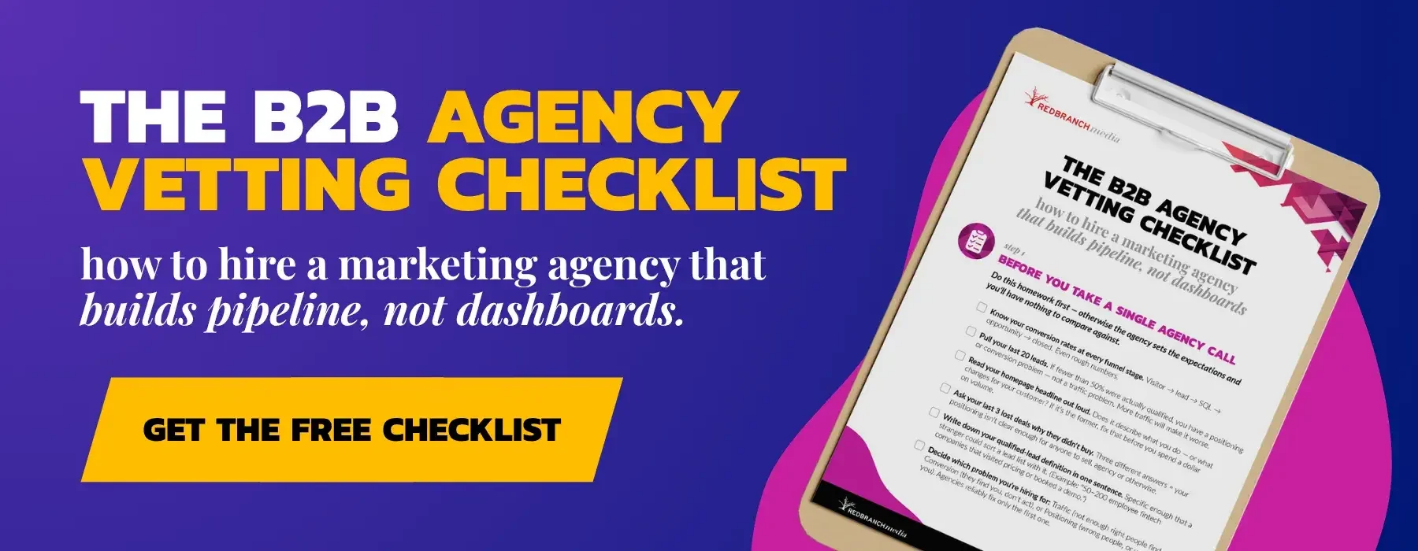
- Find your conversion rate at every funnel stage. Visitor to lead, lead to SQL, SQL to opportunity, opportunity to closed. Rough numbers are fine. You need them to tell whether an agency’s plan fixes the stage that’s broken.
- Run the 20-lead test. Pull your last 20 inbound leads and ask sales how many were qualified. If fewer than half were, more traffic will only make the problem more expensive.
- Read your homepage headline out loud. If it describes what you do and says nothing about what changes for your customer, fix it before you spend money on volume.
- Ask your last three lost deals why they didn’t buy. Three different answers means your positioning isn’t clear enough for anyone to sell, your team or an agency.
- Write your qualified-lead definition in one sentence. Make it specific enough that a stranger could sort a lead list with it. For example: “50 to 200 employee fintech companies that visited pricing or booked a demo.”
- Decide which problem you’re hiring for. The next section shows you how.
Most buyers skip step five, and it costs them. In a May 2025 Gartner survey, 49% of chief sales officers said their sales organization’s definition of a qualified lead differs greatly from marketing’s. Hire an agency before you settle that, and the agency’s definition wins by default.
Traffic, conversion or positioning: which problem are you hiring for?
Every B2B growth problem falls into one of three buckets, and each needs a different kind of partner. Most agencies are built to fix traffic. If your real problem is conversion or positioning, a traffic agency will hit its numbers and your pipeline won’t move.
| Problem | What it looks like | Quick test | Who can fix it |
|---|---|---|---|
| Traffic | The right buyers aren’t finding you | Your leads are qualified when they come, there just aren’t enough of them | Most agencies, paid and SEO specialists, demand gen teams |
| Conversion | The right buyers find you but don’t act | Healthy traffic from your ICP, low demo or contact rates, stalled opportunities | Agencies with CRO, content and sales enablement depth |
| Positioning | The wrong people show up, or the right people can’t tell why you | Fewer than half of your last 20 leads were qualified, and lost deals give scattered reasons | A partner willing to rework messaging before buying media |
We call this the traffic, conversion, positioning test: name the broken stage before you pick a partner. An agency that recommends a channel before it knows which stage is broken is selling you a service it already had on the shelf.
Agency vs. fractional CMO vs. in-house: what each is paid to produce
B2B companies have more ways to buy marketing than ever, and the labels blur. “Demand gen agency” can mean a true pipeline program or a lead-gen shop with a new website. The cleanest way to compare your options is by incentive. What each model is paid to produce decides what it reports on, and that decides which problem it can fix.
| Option | Paid to produce | Usually reports on | Can fix | Best when | Main risk |
|---|---|---|---|---|---|
| Lead-gen / MQL shop | Lead or meeting volume | CPL, MQLs, meetings booked | Traffic, sometimes | Positioning is proven and sales needs more at-bats | Volume sales rejects |
| Performance / paid media agency | Efficient media spend | Platform ROAS, CTR, CPL | Traffic | Your offer and conversion path already work | Optimizes for platform conversions over pipeline |
| Demand gen agency | Pipeline influence (in theory) | Ranges from MQLs to sourced pipeline | Traffic, some conversion | You need a program across channels | A lead-gen model with a demand gen label |
| Full-service generalist | Breadth of deliverables | Activity and output | Depends on team depth | You need many channels and have an internal strategist | Strategy spread thin |
| Vertical specialist | Category-relevant programs | Should be pipeline (ask) | Positioning, conversion, traffic | Complex buying committee, crowded category | Can be narrow on channels |
| Fractional CMO | Strategy and leadership | Plans, priorities, hiring | Positioning, prioritization | You have no senior marketing leader | A plan with no one to execute it |
| In-house team | Whatever leadership measures | Internal KPIs | All three, slowly | Stable motion, budget for several senior hires | Slow to hire, skill gaps |
Read the risk column. The fractional CMO’s weak spot is execution. The lead-gen shop’s weak spot is strategy. The model that covers both is a specialist where strategy and execution live on the same team, so the people who build the plan answer for the results.
That’s how Red Branch Media works. It’s one good option among several, and the fit section below says plainly when we’re the wrong call. If your problem is positioning or conversion and you can’t wait a year to build an internal team, it’s the row to look at closely.
Buyers seem to be heading the same direction. In Setup’s 2025 Marketing Relationship Survey, only 26% of clients agreed that generalist agencies beat specialists, a 29% drop from the year before. (Setup notes the 2025 sample was small, about 100 responses, so treat it as a directional signal.)
What questions should you ask a B2B marketing agency?
A good agency call runs both ways. Before you judge an agency’s answers, count the questions it asks you. An agency that doesn’t ask about your business has no basis for a strategy.
Five questions a good agency should ask you
Keep a tally during the call:
- Did they ask about your buying committee, the three or four roles in every deal, beyond your ICP? Forrester’s State of Business Buying, 2026 research puts the typical B2B purchase at 13 internal stakeholders and nine external influencers.
- Did they ask about your sales cycle length? A 14-day cycle and a 9-month cycle need completely different content and sequencing.
- Did they ask how your sales team defines a qualified lead?
- Did they ask about your current conversion rates and close patterns?
- Did they ask what you’ve already tried and why you think it didn’t work?
Fewer than three of these, and you’re sitting through a pitch.
Nine questions to ask every agency
- “How do you define success beyond lead volume?” Listen for pipeline, SQLs, win rate or revenue. If they lead with impressions or MQLs, that’s what they optimize for.
- “Walk me through a campaign where CPL dropped but pipeline stayed flat. What did you change?” Any agency that has run real programs has lived through this. A blank stare means they never looked past the ad platform.
- “How tightly do you work with our sales team’s feedback loop?” You want a named cadence, such as a weekly lead-quality review or a closed-lost readout.
- “Can you connect our CRM data to campaign reporting, or do you live in the ad platform?” (This is the one I’d push hardest on. If the agency can’t get campaign data and CRM data talking, every report you get is an estimate.)
- “How do you handle attribution? Will you be held to pipeline outcomes?”
- “Which channels would you invest in for us?” If they name one right away, before discovery, they picked it before they met you.
- “Will you build a named ABM list of accounts that fit our ICP, or show us a TAM slide?”
- “Who does the work?” Meet the people who will run your account. The pitch team often disappears after the contract is signed.
- “Show me results for a company with our deal size, sales cycle and industry.” Impressive logos from a different business model prove nothing about yours.
What are the red flags when hiring a marketing agency?
Walk away if you see any of these:
- 🚩 Guaranteed ROI or guaranteed meetings before they’ve seen your pipeline, onboarding or close rates. An agency that guarantees revenue based on your website alone is guessing.
- 🚩 A qualified-lead definition they bring to you. The definition should come from your sales team.
- 🚩 Reporting that lives entirely in their ad platform. Top-of-funnel dashboards with no link to pipeline leave you guessing.
- 🚩 No pushback. An agency that never says “that won’t work” or “you have a positioning problem we should fix first” is running a playbook.
- 🚩 They won’t structure a pilot. A one to three month test tracked on SQLs or revenue shows quickly whether the engagement is working.
Each of these predicts a breakup. In the same Setup 2025 survey, clients most often cited dissatisfaction with delivery and with value as reasons for leaving, 61% each, and 44% said the agency didn’t understand their business. Budget cuts ranked sixth.
Pipeline vs. activity: how to tell which agency you’re talking to
By the second call you can usually tell whether an agency is built around your pipeline or its own activity. Use this side-by-side as a cheat sheet:
| Pipeline-focused agency | Activity-focused agency |
|---|---|
| Diagnoses before prescribing, and tells you if your problem is one an agency can’t fix | Names a channel on the first call |
| Reports on pipeline stages in your CRM | Sends ad-platform dashboards |
| Builds the qualified-lead definition with your sales team | Brings its own MQL definition |
| Asks uncomfortable questions about your offer and positioning before talking channels | Talks tactics, formats and posting frequency |
| Proposes a 1 to 3 month pilot measured on SQLs or revenue | Requires a 12-month retainer before proving anything |
| Has turned down clients that weren’t a fit, and can tell you about it | Says yes to everything |
| Keeps strategy and execution on the same team | Hands the plan from strategists to a separate production team |
Count the left column. Three or more is a green light.
How should you structure an agency pilot?
Run a pilot of one to three months, measured on the same outcomes you’d judge a full engagement on: SQLs, opportunities created or pipeline value. Leave MQLs and impressions out of the scorecard.
Before you sign, put four things in writing. First, the baseline numbers, pulled from your CRM (the agency’s platform will tell a friendlier story). Second, the qualified-lead definition, signed off by sales. Third, the target and the funnel stage it lives at. Fourth, what happens at the end: scale, adjust or part ways.
Short trials are now normal in B2B buying. Forrester’s 2026 research found that more than 60% of business buyers use some form of trial before committing. An agency confident in its model should welcome a pilot. Resistance usually means it doesn’t expect its work to hold up to a pipeline measure.
How do you score your agency shortlist?
Use this rule:
An agency makes your shortlist if it asks at least three of the five questions you should be asked, shows zero red flags, and shows three or more green flags. Anything short of that, keep looking.
That rule applies to us too. We wrote this checklist, and we’d rather lose a deal on it than win one we can’t deliver on.
When Red Branch Media is (and isn’t) the right fit
Red Branch Media is a B2B marketing agency where strategy and execution sit on the same team. We work with SaaS, HR tech and PE-backed companies whose growth problem is positioning, conversion or a demand engine that produces leads sales won’t work. We’ve worked with more than 70 HR tech brands since 2010, and we report on pipeline stages in your CRM.
We’re a strong fit if you need someone to diagnose the problem and then do the work, your buying committee is complex, and your board wants to know where the pipeline came from.
We’re the wrong fit if your positioning and conversion are already proven and you only need paid media scaled, or if your main need is global PR and analyst relations at enterprise scale. A specialized performance shop or a large integrated PR agency will serve you better there, and we’ll tell you so on the first call.
What that looks like in practice
Positioning first: MP: Wired for HR. MP, a payroll and HCM firm founded in 2004, had strong technology and a service team that answers the phone. On a feature-and-price sheet, it looked like every other provider. We fixed the story before touching channels, defining MP as the “third option” between enterprise platforms and local providers. Then we built the sales deck, talk track and objection guide around it, and fixed Pardot tagging so email traffic stopped hiding in “direct.” Blog views grew from 1,228 to 4,732 in a 28-day window by late June 2026, with zero ad spend, and the brand held steady through MP’s acquisition by OneDigital. Read the MP case study.
Strategy and execution on one team: Top Employers Institute. Top Employers Institute certifies organizations on the strength of their people practices across 131 countries, but its go-to-market motion couldn’t reach the US buyers who mattered most: upper mid-market and enterprise CHROs and talent management leaders. We built the positioning first, framing the certification as the objective, data-driven global authority in a category crowded with pay-to-play programs. That positioning became the filter for everything that shipped after it. We fixed the technical SEO foundation before scaling content, built separate content tracks for CHROs and recruiters, and ran omnichannel paid media across Forbes native ads, streaming audio, display and social. The launch produced more than 1M impressions, 189k video views and 34 new inbound leads out of the gate. Read the Top Employers Institute case study.
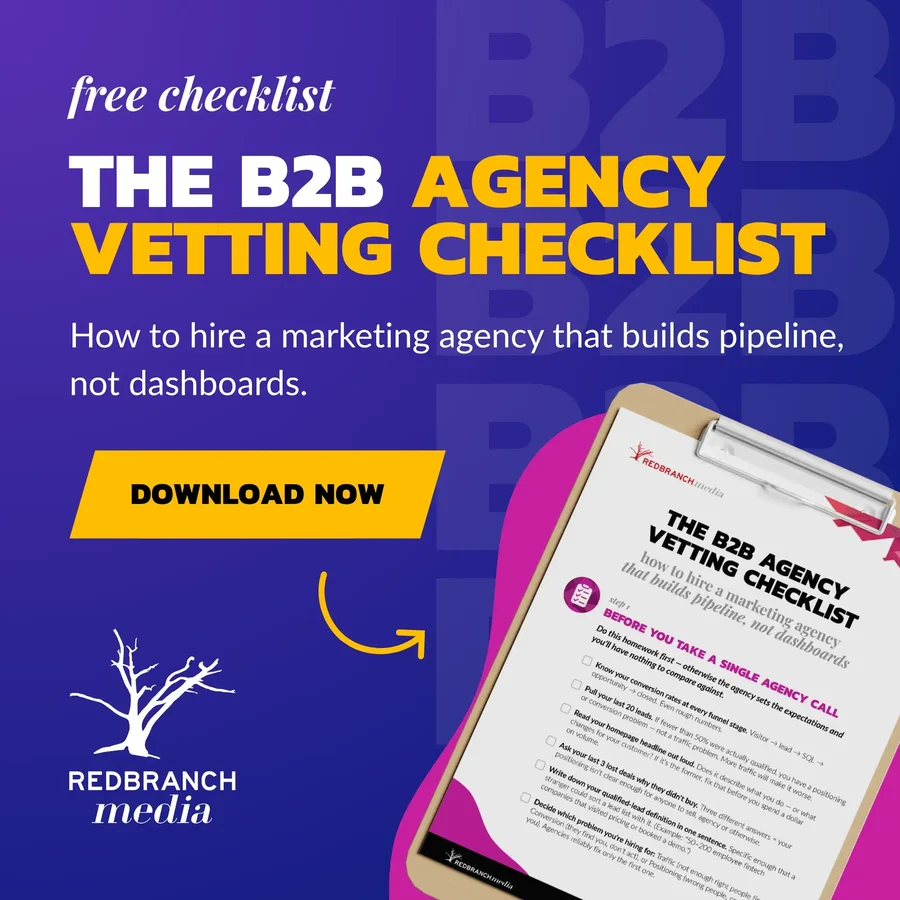
Bring this to every agency call, including ours: Download The B2B Agency Vetting Checklist (PDF)
If you’re comparing HR tech specialists by name, see our breakdown of the best HR tech marketing agencies in 2026.
Frequently Asked Questions
Start by deciding whether you have a traffic, conversion or positioning problem, then define a qualified lead with your sales team. Vet agencies on whether they ask about your business, report on pipeline in your CRM, and will run a short pilot measured on SQLs or revenue.
Look for an agency that reports on pipeline stages inside your CRM and builds its qualified-lead definition with your sales team. A strong B2B marketing agency asks about your buying committee, sales cycle and conversion rates before it recommends any channel. Red Branch Media’s B2B Agency Vetting Checklist lists the questions and red flags to bring to every call.
Ask how they define success beyond lead volume, how they handle attribution, whether they’ll connect your CRM to campaign reporting, who does the work day to day, and for results from companies with your deal size and sales cycle. Also count how many questions they ask you. Good agencies ask about your buying committee, sales cycle and qualified-lead definition first.
Guaranteed ROI or meetings before seeing your data, a qualified-lead definition they bring to you, reporting that lives only in ad platforms, no pushback on your plans, and refusing to structure a pilot.
Evaluate a marketing agency with a one to three month pilot measured on SQLs, opportunities created or pipeline value. Agree in writing on baseline numbers from your CRM, a qualified-lead definition signed off by sales, the target and its funnel stage, and what happens when the pilot ends. An agency that resists a pilot does not expect its work to hold up to a pipeline measure.
One to three months is usually enough to see movement in SQLs or opportunities, especially if baselines and the qualified-lead definition are agreed in writing first.
Pick based on the problem you’re fixing and what you’re missing. A fractional CMO gives you strategy without execution. A lead-gen agency gives you execution without strategy. An in-house team can do both but takes the longest to build. If you need positioning work and execution in the same quarter, look for a specialist agency where strategy and execution sit on one team.
Pricing varies widely by model, from project fees to monthly retainers and flexible memberships. Compare cost against the pipeline outcome you’re buying instead of the deliverable count. See Red Branch Media’s membership pricing for one example.
Table of Contents

Related Posts
Other reads you'll definitely love

 8 Minute Read
Don’t Fire the Team Before the AI Shows Up for Work
11 Minute ReadYour Contact Us Page Is Not a Sales Engine
18 Minute ReadBe the Answer: How Red Branch Media Makes Your Brand the One AI Recommends
B2B Marketing Strategy AI & Innovation Content & Thought Leadership