

(Plus More Takeaways From Sprout’s Social Intelligence Summit)
On October 29, I spent a few hours with social experts at Sprout Social’s Social Intelligence Summit and came out with a very long notes doc and a strong urge to retire some words. The theme was “social as a foundation, not just a channel,” which I translate as: your social team should not be the last to find out what your customers are saying. I spend my days on social at Red Branch Media, so this one hit close to home. Here’s the recap, organized by speaker so you know who said what.
Your competitors’ complaints are a content calendar
Jay Schwedelson, Founder, President, and CEO, GURU Media Hub/Outcome Media
Jay opened with an exercise I’m going to steal. Take the complaints already coming in and sort them into buckets. “Too expensive” is a pricing objection. “Doesn’t work” is a product failure, and “wish it had” is a missing feature. “Thinking of switching” and “alternative?” mean a buyer is already in motion and doing competitor research. “Not worth the money” is a value problem, “customer service is terrible” is a service weakness, and “why can’t I” is product frustration. “Used to love” signals declining loyalty, and “cancelled my subscription” is a churn signal. Sorted this way, a pile of angry comments starts to look like a research report.
The stakes, per Jay’s slide: 73% of social users say they’ll buy from a competitor if a brand doesn’t respond to them on social.
Point that lens at your competition
Then he aimed the same lens at everyone else. Search three competitors over the last 90 days and look for the “too expensive,” “doesn’t work,” “wish it had,” and “switching” language. Find the complaint that keeps coming up, pick one you can prove your product solves, make one us-vs-them post, and show the actual difference. You don’t even have to say their name. His slide cited the Journal of Interactive Marketing: us-vs-them posts, where brands interact with other brands, generated 108% more engagement than traditional brand posts.
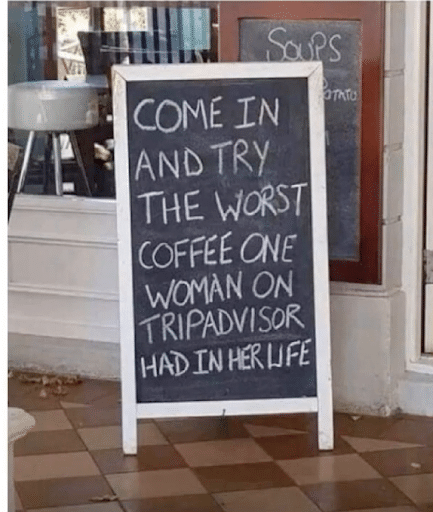
His example of doing this with humor was a sidewalk chalkboard that read, “Come in and try the worst coffee one woman on TripAdvisor had in her life.” I have thought about that sign daily since. It takes a one-star review and turns it into the reason to walk through the door, which is a better use of a bad review than most brands manage.
Comparison pages, pinned comments, and new features
Comparison pages had a moment. A 2026 study of 25,337 AI citations across ChatGPT, Perplexity, Gemini, and Google’s AI search experiences found that comparison pages earned 45% more citations per retrieval than the average page type. I will be forwarding that slide to everyone who has ever asked why comparison pages take so many drafts.
A few platform notes: pinned comments are back on LinkedIn, so consider this your sign. Jay’s broader advice is to test new features fast. You get an early visibility advantage while the platform is encouraging adoption, and platforms circulate new features even more.
The trend-to-campaign playbook
Jay’s playbook has five steps. Detect an emerging conversation before it peaks. Validate it by checking velocity, relevance, and audience fit. Align creative, brand, legal, and paid teams. Launch while the moment is still building, then learn by measuring the response and feeding it back into strategy.
Here’s why it matters: only 10% of brands act within hours of a trending event (his example was the recent Kelly Clarkson debacle), and 86% of organizations report missed opportunities because of delayed or siloed social insights. So the practices have to be approved before the moment happens. If your approval process takes longer than the trend, you aren’t joining the conversation. You’re writing its eulogy.
His version of the fix is a real-time response machine: set guardrails, assign decision owners, monitor emerging signals, activate across teams, and measure and learn. The goal, in his words, is to move at the speed of culture without skipping judgment.
Social intelligence, defined
He also gave the best definition I heard all day: social intelligence is knowing the difference between what you love and what your audience loves. To prove the point, he shared a Gary Vaynerchuk quote: “The single stupidest thing you can do in the world of marketing is to amplify content that did not do well organically.” Jay noted Gary said this to his face about his own social stuff, which is a very specific kind of feedback.
20 words to un-AI your copy
Then came the list I did not want to see. A slide called “20 Words to Un-AI Your Social Copy” showed that when certain words appear in the first three words of a post, engagement drops the following amounts. (The slide credits a Web Data Research AI study from 2026.) Here they are, worst offender first:
- game-changing: -22%
- revolutionary: -20%
- effortless: -19%
- next generation: -19%
- cutting edge: -18%
- transform: -18%
- unlock: -17%
- innovative: -17%
- maximize: -17%
- leverage: -16%
- optimize: -16%
- elevate: -16%
- discover: -15%
- harness: -15%
- seamless: -15%
- streamline: -14%
- ultimate: -14%
- powerful: -13%
- upgrade: -12%
- don’t miss: -11%
Several of these were already on our banned word list, so I’m choosing to read this as peer review.
The fix: your audience already wrote your hooks
Jay’s answer is a customer-language hook test. Pull 50 comments from your last five posts and look for the exact phrases that keep showing up. Turn those phrases into hooks, then create three versions of a post, changing only the opening. Use the winner everywhere: your next reel, carousel, paid social ad, organic posts, landing page, and email subject line. So instead of asking AI to sound human, borrow the way your audience already talks. My notes also say, “AI is not taking your job (Period!!),” and I stand by whoever wrote that.
First to know, first to move
Tulani André, VP Social Media, Content & Creator, Zalando SE, and Josh Rangel, Senior Director, Social Strategy, Ogilvy, Moderated by Cat Anderson at Sprout.
Before you jump on a trend, ask whether you have something of value to say or whether you’ll vanish into the sea of sameness. That gets harder when everyone is using the same AI tools, so being unique matters more than ever. Speed matters too, but speed only works if the right people have said yes before it counts.
Their answer is to set guidelines with legal in advance: here’s the category we want to play in, and here’s the line we will never cross. That way you can hop on a trend before it’s too late. Then align on why it makes sense for the brand to post at all, tie it to a business objective, and report on performance after it launches.
Josh’s personal Ogilvy example was something I am beyond excited for. SC Johnson’s Ziploc was listening to social media and found that people wanted a cereal bag in a Ziploc format, then partnered with General Mills to make it happen (I’m serious. Check it out here. ). Somewhere a social listening report said “people want cereal in a Ziploc,” and someone in a meeting took it seriously. Write that down, Write that down!!
From signals into strategy
Benedict Nicholson, Content Manager, Sprout Social; Curtis Midkiff, Director, Social Media Marketing, Sprout Social; Bianca Shaw, Digital & Social Strategy Advisor; and Paige Walker, Manager, Foresight, Consumer & Market Signals, The Hershey Company
The panel’s first question is one I’m going to start asking in every planning meeting: will this trend stay on TikTok, or will it spread to multiple channels? Knowing that before you commit changes how you build it.
Turning social into something that changes the business: Hershey’s Dubai chocolate launch was the case study. They joined the trend late, and it still worked, though the panel was clear that it all depends on the business. That was the most comforting thing I heard all morning, and also not a plan. Their practical advice was to take one signal you find, bring it to a team, and find one outcome from it.
Borrowed trust, real impact
Lia Haberman, Founder, ICYMI; Brandon Smithwrick, Creator & Content Strategist, Content to Commas; Ari Berkowitz, Head of Creator Solutions, PMG; and Cory Weaver, Head of Creator Marketing, Gap Inc.
The theme here was that the subject matters more than the number of followers a creator has. A slide titled “Trust is moving beyond the brand handle” backed it up: only 17% of consumers say follower count matters when evaluating an influencer, 80% want influencers to have actually used the product they’re promoting, and 77% discover new products through employee content at least sometimes.
Brands the speakers said are doing it well include LinkedIn, with vertical video vignettes of employees talking about the products, and the “Staples Baddie.” There were also brands that bring humanity into their content, like Chili’s, Pacsun’s TikTok shop, and YSL’s block parties. Ocean Spray took creators on a trip to the bog, which might be the most on-brand field trip in marketing history. As everyday people, we relate more to trips like this than to extravagant ones abroad. The last takeaway was to differentiate your employee advocacy programs from your influencer programs, since they serve different purposes.
Tomorrow is talking
Sprout’s Benedict Nicholson closed with an easy framework for putting social intelligence to work. Signal: spot the pattern, whether that’s a spike, a complaint cluster, or a rising trend in the numbers you already report. Evidence: share the proof by benchmarking it, checking share of conversation, and confirming it with a second source. Action: hand over the decision by assigning a named recommendation to each team.
So everyone, please, go read your comments. They’ve been talking this whole time.
Frequently Asked Questions
Social listening is the practice of monitoring what customers, prospects, and competitors’ customers say on social channels and turning those conversations into decisions. It goes beyond tracking mentions: complaints, feature requests, and switching signals become inputs for content, product, and campaign strategy.
Social intelligence is knowing the difference between what your brand loves and what your audience loves. It means using social signals, such as comment patterns, complaint clusters, and rising trends, as evidence for business decisions rather than treating social as a standalone channel.
Start by sorting incoming complaints into buckets such as pricing objections, product failures, missing features, and churn signals. Then run the same search on three competitors over the last 90 days, find a recurring complaint your product solves, and build content that shows the difference. Pre-approve guardrails with legal so the team can act on trends quickly.
Social listening shows brands what customers want before competitors act on it. SC Johnson’s Ziploc found through social listening that people wanted cereal in a Ziploc-style bag and partnered with General Mills to make it. Brands that ignore those signals miss product, content, and campaign opportunities.
Social listening gives brands hooks written in their customers’ own language. Pull 50 comments from your last five posts, find phrases that repeat, turn them into opening lines, and test three versions of a post that change only the hook. The winning version can then be reused across ads, landing pages, and email subject lines.
Table of Contents

Related Posts
Other reads you'll definitely love

 7 Minute Read
What Is Conscious Design, and Why Does It Matter?
 6 Minute Read
57,000 Jobs Added. 62,000 Cut. Same Month. Nobody’s Explaining Why.
 9 Minute Read